
Chicken Road is one of the most talked-about entries in the current wave of "crash" style casino games — titles that ask you to cash out before a rising multiplier collapses. Instead of a rocket flying off screen, Chicken Road puts a cartoon chicken on a busy road, hopping from lane to lane. Every successful hop increases your potential payout; one wrong step and the round ends. This page is an independent, informational breakdown of how the game works, what the numbers actually mean, and what to weigh up before you decide to play — we do not operate any casino and we do not accept wagers ourselves.
How Chicken Road Works
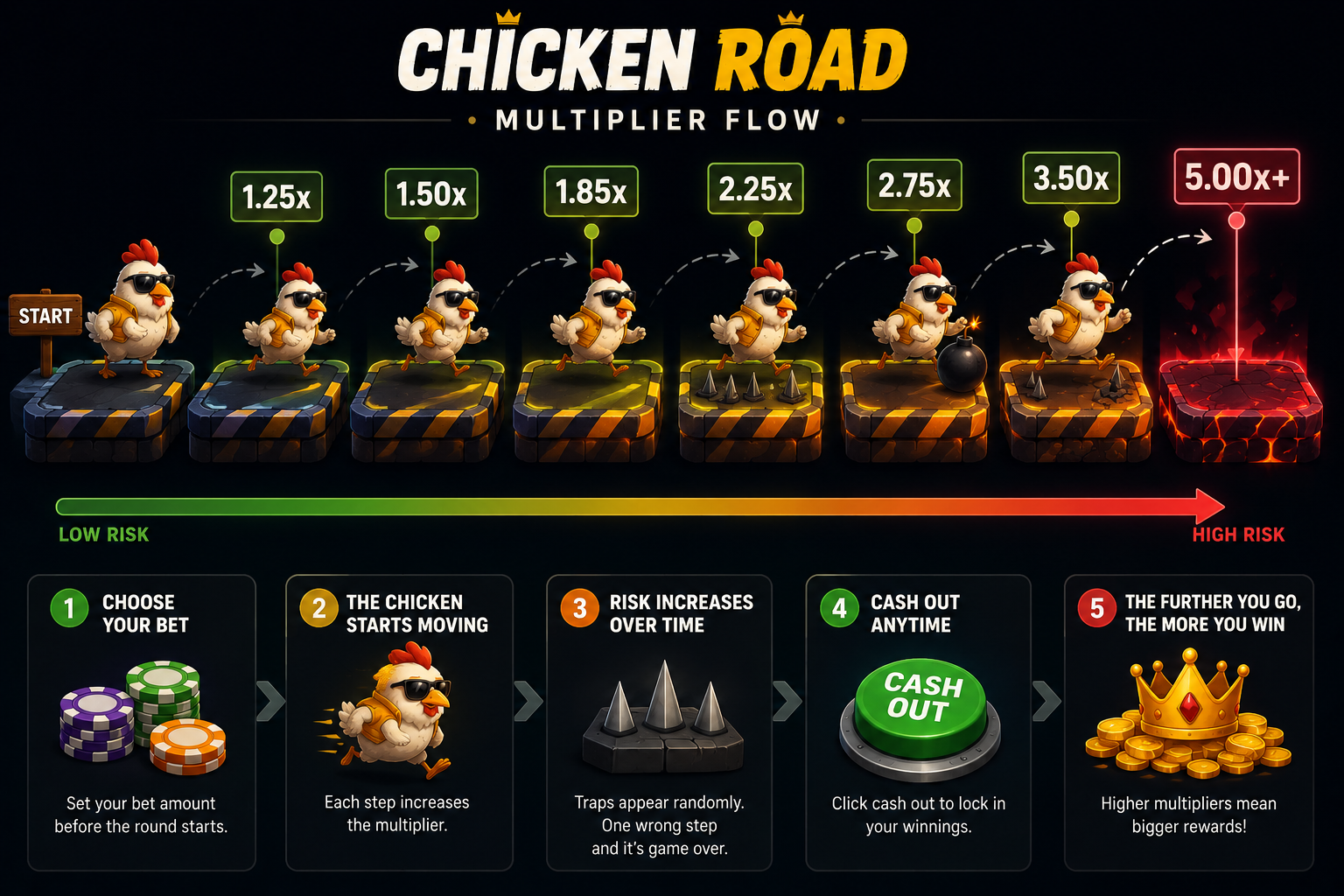
The mechanics are simple to learn, which is part of the appeal. You place a stake, and the chicken begins hopping across a multi-lane road divided into segments. Each lane you clear safely nudges the multiplier upward, and you can choose to cash out after any successful hop. If the chicken is hit while crossing a lane, the round ends immediately and the stake for that round is lost. There is no fixed number of lanes required — you decide, hop by hop, whether to press on for a bigger multiplier or lock in what you have already earned.
Behind the animation sits a certified random number generator (RNG). Before each hop, the game determines — independently of anything that happened in previous rounds — whether that lane is "safe" or not, weighted according to the game's built-in house edge. There is no hidden pattern to detect and no "hot" or "cold" streak; every hop is a fresh, independent event.
Difficulty Levels and Risk Settings
Most implementations of Chicken Road let you choose a difficulty setting before starting a round — commonly labeled something like Easy, Medium, Hard, and Hardcore (naming varies slightly between studios and casino skins). The setting changes two things simultaneously: the probability of a safe hop, and the size of the multiplier awarded for clearing that lane.
- Easy mode — a high chance of a safe hop on each lane, paired with a small multiplier increase per hop. Rounds tend to last longer and feel steadier, but the ceiling on any single round is comparatively modest.
- Medium mode — a balanced middle ground between hop safety and multiplier growth, often the default setting new players are shown.
- Hard mode — noticeably lower odds of a safe hop, compensated by a much steeper multiplier curve. Rounds end sooner on average, but a lucky streak of hops can produce a large multiplier quickly.
- Hardcore mode — the highest risk setting, where a single lane may carry a real chance of ending the round, but the reward for surviving several hops in a row can be dramatic.
| Difficulty | Safe-Hop Odds | Multiplier Growth | Best For |
|---|---|---|---|
| Easy | High | Small, steady increments | New or cautious players |
| Medium | Balanced | Moderate | Most players |
| Hard | Lower | Steep | Experienced, risk-tolerant players |
| Hardcore | Lowest | Very steep | Players deliberately seeking maximum volatility |
None of these settings change the underlying house edge in a way that favors the player — they only change the shape of the risk, trading a higher chance of a small win for a lower chance of a large one, or vice versa.
Understanding RTP and House Edge
RTP (Return to Player) is the theoretical long-run payback percentage of a game, calculated over millions of simulated rounds rather than any single session. Chicken Road variants generally sit in the mid-90s percent range, which is broadly in line with other crash-style and provably-fair casino games. The remainder is the house edge — the mathematical advantage that keeps the game commercially viable for the operator over time.
It is worth being clear about what RTP does and doesn't tell you. It says nothing about what will happen in your next ten rounds; it is a statement about the aggregate behavior of the game across a very large sample. Short-term results can and do swing well above or below the theoretical RTP in either direction — that variance is the entire appeal of the game, and also the reason it should always be treated as entertainment with real financial risk, not a reliable way to make money.
Where Chicken Road Fits Among Crash Games
Chicken Road belongs to a broader family of multiplier-based crash games that also includes titles like Aviator, JetX, and Aviatrix. What sets it apart visually is the lane-by-lane structure, which gives players a discrete decision point after every single step rather than a continuously rising curve. We cover how it stacks up against those alternatives — including differences in pacing, visual style, and typical volatility — on our dedicated comparison page.
Provable Fairness
Reputable studios that produce Chicken Road-style games typically implement a provably fair system, allowing a player to verify after the fact that a round's outcome was generated fairly and was not altered once the stake was placed. This usually involves a cryptographic hash of the server seed being shown before a round begins, with the seed itself revealed afterward so the result can be independently checked. Not every casino surfaces this feature equally clearly, so it is worth checking a casino's help section for how it documents fairness verification.
A Sensible Way to Approach the Game
Because every hop is an independent random event, no staking pattern changes the underlying odds. What does matter is treating the game as entertainment with a real cost: setting a loss limit before you start, deciding in advance roughly where you intend to cash out rather than deciding in the heat of the moment, and stopping when either your budget or your session time is used up. Our strategies page goes into more detail on cash-out planning and bankroll thinking, without pretending any method can overcome the built-in house edge.
Who Offers Chicken Road
Chicken Road, and titles built on a similar mechanic, are distributed by a handful of game studios to online casinos under license in regulated markets. Our casinos page rounds up operators that currently list generous welcome terms specifically applicable to crash-style games, and our mobile gaming page focuses on the casinos with the smoothest app and browser experience for playing on a phone.
Glossary: Key Chicken Road Terms
A handful of terms come up repeatedly across this guide and around the game generally. Here's what each one actually means in context:
- RTP (Return to Player) — the theoretical percentage of wagered money a game pays back over a very large number of rounds; the inverse of house edge.
- House edge — the mathematical advantage built into the game that keeps it profitable for the operator over time, expressed as a percentage of total wagers.
- RNG (Random Number Generator) — the certified algorithm that decides whether each lane hop is safe, independently of every previous hop or round.
- Provably fair — a verification system, usually based on cryptographic hashing, that lets a player confirm after the fact that a round's result wasn't altered once the stake was placed.
- Multiplier — the factor by which your stake grows with each successful hop, shown live during the round and locked in the moment you cash out.
- Volatility — how much a game's results swing around its average RTP in the short term; higher-difficulty settings in Chicken Road increase volatility without changing the long-run average.
- Cash out — the action of ending your round voluntarily to collect the current multiplier, before a lane hop potentially ends it for you.
Common Mistakes New Players Make
Most avoidable losses in Chicken Road trace back to a handful of repeated habits rather than bad luck alone:
- Treating a winning streak as a signal — a run of safe hops says nothing about the next one; the RNG has no memory, so raising your stake because you "feel" a streak continuing is a common way a good session turns into a bad one.
- Switching difficulty mid-session on impulse — jumping to Hardcore after a win, or dropping to Easy after a loss, replaces a plan with a reaction; see our strategies page for a steadier approach.
- Confusing RTP with a guarantee — a mid-90s RTP describes millions of rounds in aggregate, not what will happen in your next ten; short sessions can and do land well outside that average in either direction.
- Skipping the demo mode — where available, a free-play demo is a low-cost way to get a feel for how quickly a given difficulty setting's multiplier grows before wagering real money.
- Not deciding a stop-loss in advance — deciding a limit after you've already started losing tends to produce a higher number than deciding it beforehand, in a calm moment.